
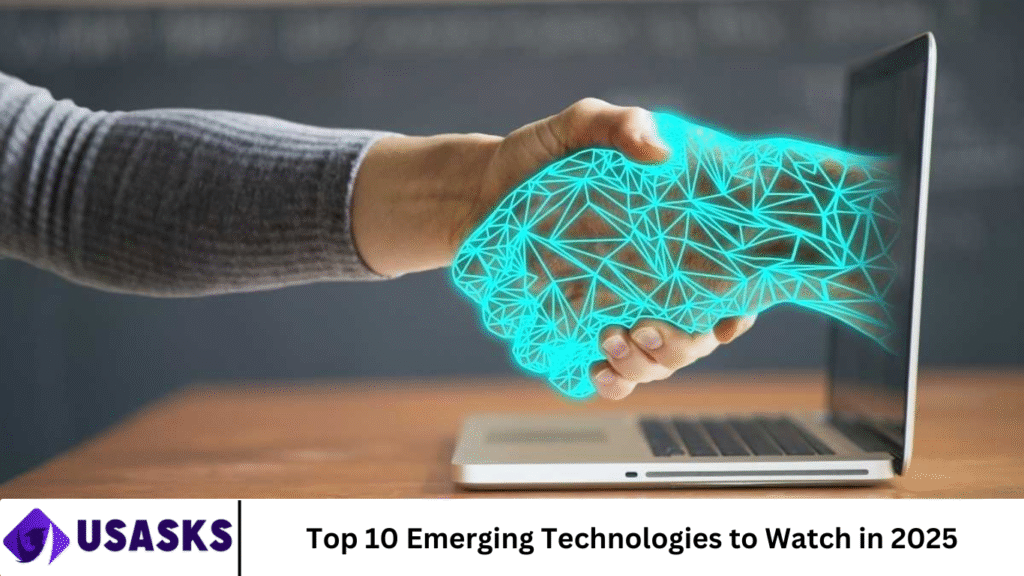
The technology landscape is evolving faster than ever, shaping industries, economies, and everyday life. As we approach 2025, a new wave of breakthrough innovations promises to transform how we work, communicate, and live sustainably.
From revolutionary advances in artificial intelligence to greener ways of producing essential materials, the top emerging technologies of 2025 are setting the stage for a more connected, efficient, and resilient world.
We explore the Top 10 Emerging Technologies to Watch in 2025, highlighting their potential impact, current state of development, and the societal benefits they aim to deliver. Whether you’re a business leader, tech enthusiast, policymaker, or just curious about the future, understanding these technologies is key to staying ahead in a rapidly changing world.
More Read: Google Rolls Out AI Mode with New Features to All U.S. Search Users
1. Generative AI Watermarking: Securing the Future of Content Creation
Artificial Intelligence (AI) continues to advance at a breakneck pace, and generative AI is one of its most exciting frontiers. By 2025, technologies that embed watermarks into AI-generated content—images, videos, and text—are becoming crucial to ensure authenticity, combat misinformation, and protect intellectual property.
With the rise of AI tools creating hyper-realistic media, AI watermarking serves as a digital signature, allowing creators, platforms, and consumers to verify the source and originality of content. This innovation is poised to support ethical AI use and strengthen trust across digital ecosystems.
Why It Matters:
- Prevents deepfake abuse and misinformation spread
- Protects artists and content creators’ rights
- Encourages responsible AI adoption across industries
2. Green Ammonia: Revolutionizing Fertilizer Production for a Sustainable Future
Traditional fertilizer production is energy-intensive and a significant contributor to global greenhouse gas emissions. Enter green ammonia, a game-changing technology that produces ammonia—an essential fertilizer component—using renewable energy instead of fossil fuels.
By 2025, green ammonia production is set to scale, reducing the carbon footprint of agriculture and supporting food security worldwide. This emerging technology aligns with global climate goals and offers a pathway toward sustainable farming practices.
Key Benefits:
- Cuts emissions from fertilizer manufacturing
- Enables cleaner energy storage and transport
- Supports sustainable agricultural growth
3. AI-Powered Drug Discovery: Accelerating Medical Breakthroughs
Healthcare is being transformed by AI-driven drug discovery platforms that can analyze massive datasets, identify potential compounds, and predict their efficacy far faster than traditional methods. By 2025, these platforms will significantly reduce the time and cost of developing new medicines, enabling faster responses to emerging health threats and personalized treatments.
This technology not only speeds up the process but also enhances precision, leading to more effective therapies with fewer side effects.
Impact on Healthcare:
- Speeds up vaccine and drug development
- Enables personalized medicine tailored to individual genetics
- Improves global health outcomes through faster innovation
4. Advanced Nuclear Fusion: A Clean Energy Revolution
One of the most ambitious energy technologies, nuclear fusion—the process that powers the sun—has long promised nearly limitless, clean energy. After decades of research, fusion is nearing a practical breakthrough, with pilot reactors expected to come online around 2025.
Fusion energy could revolutionize the global energy landscape by providing abundant, carbon-free power with minimal radioactive waste, helping to combat climate change on a massive scale.
Why Fusion Matters:
- Provides a nearly inexhaustible energy source
- Generates zero greenhouse gas emissions during operation
- Reduces dependency on fossil fuels
5. Next-Generation Quantum Computing: Unlocking New Possibilities
Quantum computing is set to change the way we solve complex problems in fields ranging from cryptography to materials science. By 2025, next-generation quantum computers will have increased qubit stability and scalability, allowing for practical applications in logistics, drug discovery, and climate modeling.
While still in early stages, these machines can perform calculations beyond the reach of classical computers, unlocking new solutions to previously unsolvable challenges.
Potential Applications:
- Breakthroughs in encryption and cybersecurity
- Accelerated material and drug design
- Enhanced climate prediction models
6. Biodegradable Electronics: Tackling E-Waste Sustainably
With electronic waste posing a growing environmental challenge, biodegradable electronics offer an innovative solution. These devices are designed to break down naturally after use, reducing landfill impact and pollution.
By 2025, advances in biodegradable materials will enable the production of consumer gadgets, medical implants, and sensors that leave little environmental footprint, promoting a circular economy.
Environmental Benefits:
- Significantly reduces e-waste accumulation
- Supports eco-friendly product design
- Opens new possibilities for temporary medical devices
7. Personalized Learning Platforms Powered by AI
Education is undergoing a transformation with AI-powered personalized learning platforms that adapt to each student’s needs, learning pace, and style. By 2025, these platforms will be widespread, helping learners worldwide achieve better outcomes through customized content and real-time feedback.
This technology can close educational gaps, enhance engagement, and prepare learners for the demands of the future workforce.
Advantages in Education:
- Tailors learning experiences to individual strengths
- Enables lifelong learning and skill development
- Supports educators with data-driven insights
8. Smart Urban Infrastructure: Building Resilient Cities
As urban populations grow, smart infrastructure integrates IoT, AI, and sustainable design to create cities that are safer, more efficient, and environmentally friendly. Technologies such as intelligent traffic systems, energy-efficient buildings, and real-time environmental monitoring will mature by 2025.
Smart urban infrastructure not only improves quality of life but also helps cities adapt to climate change and resource constraints.
Key Features:
- Reduces energy consumption and pollution
- Enhances public safety and transportation efficiency
- Promotes sustainable urban growth
9. Synthetic Biology: Engineering Life for the Future
Synthetic biology uses engineering principles to redesign organisms for beneficial purposes, from producing biofuels to creating new medicines. By 2025, synthetic biology will accelerate in sectors like agriculture, healthcare, and environmental management.
This technology holds promise for solving critical challenges such as food shortages and disease treatment through innovative, bioengineered solutions.
Applications to Watch:
- Developing sustainable biofuels and materials
- Creating novel therapies and vaccines
- Enhancing crop resilience and yield
10. Space-Based Solar Power: Harnessing Energy Beyond Earth
Space-based solar power systems capture sunlight in orbit and transmit energy back to Earth, offering a constant, clean energy source unaffected by weather or time of day. Though still in experimental phases, this technology is advancing rapidly and could become viable by 2025.
Space-based solar power could complement terrestrial renewables and play a pivotal role in meeting growing energy demands sustainably.
Why It’s a Game-Changer:
- Provides uninterrupted renewable energy
- Reduces land use conflicts with solar farms
- Supports global energy security
Frequently Asked Question
What are the top emerging technologies to watch in 2025?
The top technologies include generative AI watermarking, green ammonia production, AI-powered drug discovery, nuclear fusion energy, quantum computing, biodegradable electronics, personalized learning platforms, smart infrastructure, synthetic biology, and space-based solar power.
Why are these technologies considered “emerging”?
These technologies are labeled as emerging because they are at a tipping point—where scientific progress is transitioning into real-world applications with the potential for widespread societal and economic impact.
How will these technologies impact daily life by 2025?
From improved healthcare and education to cleaner energy and smarter cities, these technologies are expected to enhance quality of life, increase efficiency, and support global sustainability efforts.
Which industries will benefit most from these innovations?
Key sectors poised to benefit include healthcare, energy, agriculture, education, urban planning, and information technology, as they adopt tools like AI, fusion energy, and bioengineering to innovate.
What role does artificial intelligence play in these emerging technologies?
AI is a core enabler in several of the top technologies for 2025, driving advancements in drug discovery, education personalization, generative content verification, and smart city infrastructure.
Are these technologies environmentally sustainable?
Many of the 2025 emerging technologies focus on sustainability—such as green ammonia, biodegradable electronics, nuclear fusion, and space-based solar power—helping reduce carbon emissions and resource waste.
How can individuals and businesses prepare for these changes?
Staying informed, investing in digital skills, supporting innovation-friendly policies, and adopting flexible, forward-looking strategies will help both individuals and organizations thrive in a rapidly evolving tech landscape.
Conclusion
The top emerging technologies of 2025 represent a fusion of innovation, sustainability, and practical application. As these technologies move from research labs to real-world deployment, their potential to address global challenges—from climate change to healthcare and education—is immense. Staying informed about these developments helps governments, businesses, and individuals make strategic decisions to harness the benefits and navigate potential risks. Embracing innovation will be critical for creating a prosperous, equitable, and sustainable future.
